
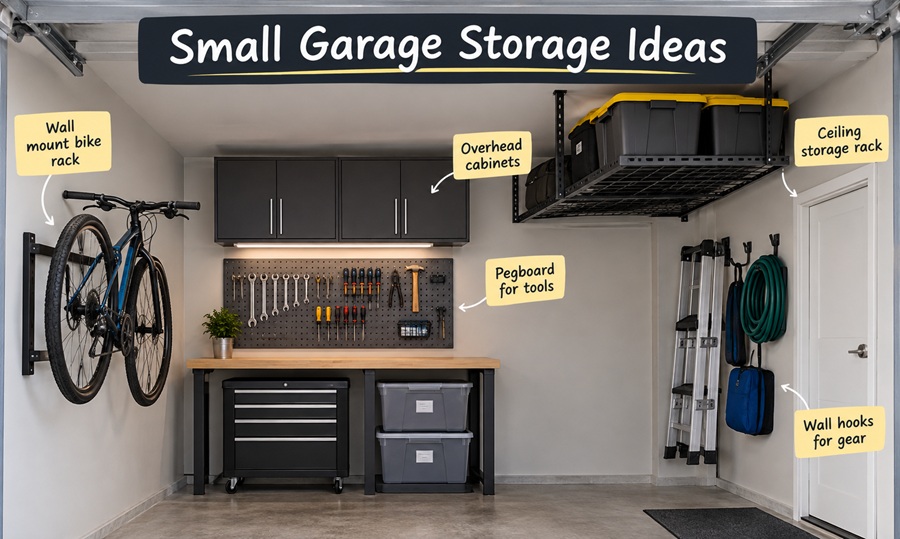
Somewhere between the holiday decorations, the bikes nobody rides anymore, and three half-used cans of paint, most small garages stop being able to fit an actual car. It’s not usually a storage problem so much as a storage strategy problem — everything is on the floor, competing for the same 200 square feet.
| Quick Answer
The most effective small garage storage ideas move items off the floor entirely: overhead ceiling racks for seasonal gear, slat wall or pegboard systems for tools, and stackable clear bins on wall-mounted shelving. Vertical storage typically reclaims 30 to 40 percent more usable floor space than freestanding shelves alone. |
Rule One: Get Everything Off the Floor
Floor space in a small garage is the most valuable and most wasted resource in the room. Every bin, box, or bike stored on the ground is square footage the car can’t use. The fix is almost always vertical: walls and ceilings in a typical garage offer more storable area than the floor does, and they’re almost always empty.
Overhead Storage Racks
Ceiling-mounted racks are the single highest-impact addition for seasonal items — holiday bins, camping gear, luggage — that don’t need daily access. Most systems mount to ceiling joists and hold 250 to 600 pounds, well above what most households actually store overhead.
- Confirm joist spacing before installing; most racks require mounting into joists, not drywall alone
- Leave at least 12 inches of clearance between the rack and any garage door track
- Store the heaviest bins closest to the ladder access point you’ll use most
- Label bin contents on the side facing outward, since lids won’t be visible from below
Wall Systems: Slat Wall vs. Pegboard vs. French Cleat
| System | Weight Capacity | Cost | Best For |
|---|---|---|---|
| Pegboard | Light to medium tools | $ | Hand tools, small hardware |
| Slat wall panels | Medium to heavy | $$ | Bikes, ladders, bulky equipment |
| French cleat system | Heavy, fully modular | $$ | Custom shelving, cabinets, bins |
| Metal grid wall | Medium | $$ | Rakes, hoses, sports gear |
Pegboard remains the cheapest entry point and works well for anything light enough to hang on a hook. French cleat systems cost more upfront but let you build a fully custom wall of shelves, bins, and cabinets that can be rearranged in minutes without new holes.
Zone the Garage Like a Small Kitchen
Professional organizers treat a small garage the same way they’d treat a small kitchen: define zones by activity, not by item type. A tool zone, a sports-equipment zone, a seasonal-storage zone, and a yard-work zone each get their own wall section or shelf run, rather than scattering similar items across the whole space.
- Empty the garage completely and sort everything into rough categories on the driveway
- Assign each category a wall section, prioritizing eye-level and easy-reach zones for frequently used items
- Install wall storage before bringing anything back in
- Return items zone by zone, heaviest and least-used items going into overhead or high shelving
- Reassess after two weeks and adjust zones that aren’t working in practice
| Tip: Keep a 3-foot clear path from the man door to the garage door at all times. It’s the single most common safety oversight in DIY garage reorganizations. |
Clear Bins Beat Cardboard Every Time
Cardboard boxes absorb moisture, sag under weight, and attract pests in a garage environment far more than in a closet. Uniform clear plastic bins with snap lids stack more securely, resist humidity, and let you see contents without opening every box on a shelf.
Working Around a Single-Car Footprint
In a true one-car garage, every inch of wall matters more than in a two-car space. Prioritize storage along the non-door walls first, and consider a slim rolling cart for tools that need to move with you rather than a fixed workbench that eats permanent floor space.
- Fold-down wall-mounted workbenches free the floor when not in use
- Narrow vertical cabinets fit in the strip between the car and the wall
- Bike hooks or pulley systems lift bicycles entirely off the floor
- Corner shelving units use the one area cars never occupy
FAQs
How much weight can an overhead garage rack safely hold?
Most consumer-grade ceiling racks are rated between 250 and 600 pounds, but the real limit is often the ceiling joists themselves, so always mount into joists and check the manufacturer’s per-rack rating.
What’s the cheapest way to organize a small garage?
A basic pegboard wall with hooks is typically the lowest-cost option, followed by stackable clear bins on a simple metal shelving unit.
Can I install garage wall storage myself?
Yes, most pegboard and slat wall systems are designed for DIY installation with a stud finder, level, and basic tools; French cleat systems are similarly approachable for most homeowners.
How do I keep a small garage from feeling cluttered even with storage?
Group items by zone rather than by type, use uniform bins instead of mismatched boxes, and keep frequently used items at eye level so nothing needs to be dug out.
Is it worth building custom cabinets in a small garage?
For garages with recurring storage needs and a longer-term home, custom cabinetry often pays off in durability and exact-fit space use; for renters or short-term homeowners, modular wall systems offer similar benefits without the investment.
Final Thought
A small garage isn’t a lost cause, it’s just a space where every wall and every inch of ceiling has to earn its keep. Move belongings up and out of the way, zone what’s left, and the same 200 square feet that used to swallow a car whole will finally have room for one.