
What the NASA Study Actually Said
Almost every list of air-purifying plants traces back to a single NASA study from the late 1980s that tested how plants absorbed volatile organic compounds inside sealed chambers. The results were genuinely promising in that controlled setting, but the study never claimed a couple of houseplants could meaningfully clean the air in an actual living room.
Later research, including work reviewed by environmental scientists in the 2010s, found that in a real room with normal air exchange, you’d need dozens of plants per square foot to match the air-cleaning effect measured in that sealed chamber. That doesn’t mean plants are useless indoors — it means the benefit is more modest, and more about which specific compounds a plant handles well.
Top Plants Worth Growing for Air Quality
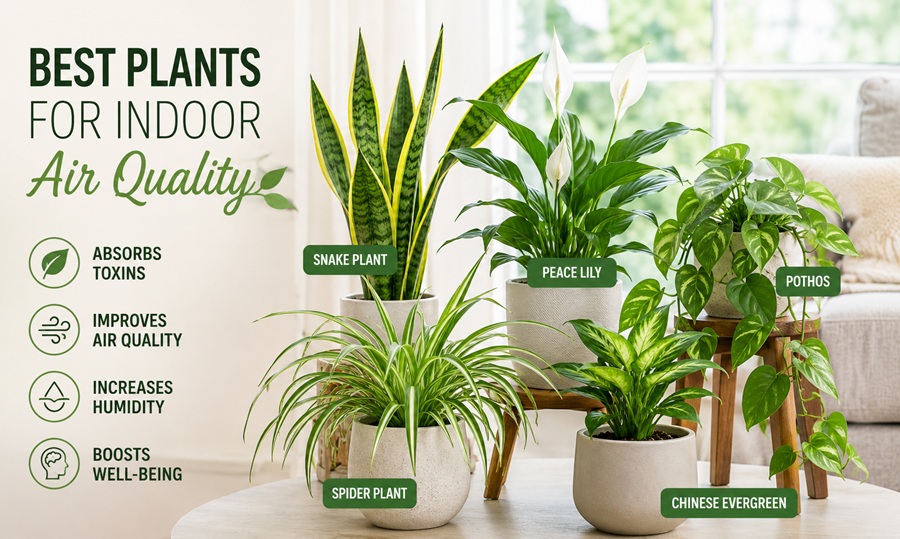
Snake Plant (Dracaena trifasciata)
Snake plants tolerate low light, irregular watering, and neglect better than almost any other houseplant, which is part of why they show up on so many recommended lists. They’re also one of the few common plants that release oxygen at night rather than absorbing it, making them a reasonable choice for a bedroom.
Pothos (Epipremnum aureum)
Pothos grows quickly, roots easily in water, and handles a wide range of light conditions, which makes it one of the most forgiving options for anyone new to houseplants. It was among the strongest performers in early VOC-absorption research.
Spider Plant (Chlorophytum comosum)
Spider plants are considered non-toxic to pets, which sets them apart from several other entries on this list, and they propagate easily from the small plantlets they send out on long runners.
Peace Lily (Spathiphyllum)
Peace lilies flower indoors more reliably than most houseplants and were one of the top performers in the original NASA testing. They do require more consistent watering than snake plants or pothos, and they’re toxic to pets if chewed.
| Plant | Light Needs | Watering | Pet Safe? |
|---|---|---|---|
| Snake Plant | Low to bright indirect | Every 2–3 weeks | No |
| Pothos | Low to bright indirect | When top soil is dry | No |
| Spider Plant | Bright indirect | Weekly | Yes |
| Peace Lily | Medium to low | Weekly, keeps soil moist | No |
| Rubber Plant | Bright indirect | Every 1–2 weeks | No |
How Many Plants Would You Actually Need?
This is where most popular articles overstate the benefit. Realistic estimates from air-quality researchers suggest you’d need somewhere around one plant per 100 square feet to notice even a modest measurable difference, and considerably more to approach anything like whole-room filtration.
| Note: Plants are a complement to good ventilation, not a substitute for it. Opening windows, using exhaust fans, and maintaining HVAC filters do more for indoor air quality than any number of houseplants. |
Choosing Plants by Room
- Bedrooms: snake plant or aloe vera, both release oxygen overnight
- Bathrooms: pothos or Boston fern, both tolerate higher humidity
- Living rooms: rubber plant or peace lily for larger, more decorative options
- Home offices: spider plant, which handles fluctuating light from blinds and screens well
- Kitchens: English ivy, which some studies link to reduced airborne mold spore counts
Simple Care Habits That Matter More Than the Species
- Dust leaves regularly so they can photosynthesize efficiently
- Avoid overwatering, which is the leading cause of houseplant death and root rot
- Rotate pots occasionally so growth doesn’t lean permanently toward one light source
- Repot every 12 to 18 months as roots outgrow their container
Frequently Asked Questions
1. Do air-purifying plants really remove toxins from the air?
They absorb some volatile organic compounds in lab conditions, but the effect in a normal, ventilated room is much smaller than popular lists suggest. Think modest improvement, not full filtration.
2. Which plant is best for a low-light apartment?
Snake plants and pothos are the most forgiving in low-light conditions and are among the few plants that genuinely thrive without much direct sun.
3. Are air-purifying plants safe for homes with pets?
Not all of them. Spider plants are generally considered pet-safe, but peace lilies, pothos, and snake plants can be toxic if chewed, so keep them out of reach if you have curious cats or dogs.
4. How many plants do I need to notice a real difference?
Realistic estimates suggest roughly one plant per 100 square feet for even a modest effect, which is far more plants than most casual lists imply.
5. Can houseplants replace an air purifier?
No. Mechanical air purifiers and good ventilation address particulates and airflow at a scale houseplants simply can’t match. Plants are a nice addition, not a replacement.
The honest takeaway is that plants make a genuine but modest contribution to indoor air quality, and a considerably bigger contribution to how a room feels to live in. Choose species that match your light and pet situation, keep them healthy, and treat them as one small piece of a larger air-quality picture that includes ventilation and filtration.